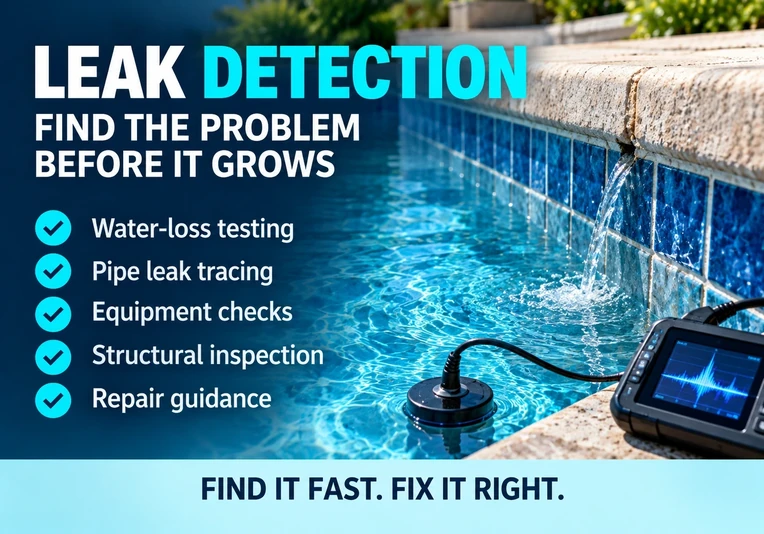
Every outdoor pool loses some water naturally. Sun, temperature, humidity and wind all affect evaporation, and a windy coastal day can noticeably increase it. The problem is knowing when normal evaporation has become abnormal water loss from equipment, plumbing or the pool shell.
If the water level is falling repeatedly, start with simple observations before assuming the worst. Pool Crew offers pool leak detection, but the checks below can help you give us much better information before an inspection.
First, rule out obvious equipment leaks
With the system running, inspect the pump, filter, chlorinator, heater connections if fitted, visible valves and pipe unions. Look for active drips, wet concrete, green staining, mineral deposits or soil that stays damp.
A pump mechanical seal can leak only while the motor is running. A filter multiport valve can send water to waste unexpectedly. A union can seep only under pressure. If you find a pump-side concern, see pump repairs; for filter valves, tanks or pressure concerns, see filter repairs.
Use a bucket comparison rather than guessing
A simple comparison can help distinguish evaporation from a possible leak. Place a bucket or container where it experiences similar weather, mark the water level in the container and mark the pool level. After a suitable comparison period, compare the two drops. The idea is not laboratory precision — it is to see whether the pool is losing materially more water than the comparison water surface.
The US EPA WaterSense pool-efficiency guidance identifies evaporation as a major source of pool water loss and explains how covers can reduce it. If the pool loses substantially more than the comparison container, investigate further.
Does the loss change when the pump is on?
Note whether water loss appears worse while the circulation system is running or while it is off. A change can help narrow the search because different sections of plumbing operate under suction or pressure depending on pump state. It is not a definitive diagnosis, but it is useful information for a technician.
If you also notice bubbles at the returns, a pump basket that will not stay full, difficulty priming or unstable flow, read our pool pump warning-sign guide.
Watch where the water level stops
Sometimes a leak slows or stops when the level drops below a fitting, light, skimmer or crack. That can be a clue. Do not intentionally drain a pool deeply without professional advice, especially where groundwater or structural movement may be a concern. Simply observe the natural pattern and photograph it.
Look for less obvious clues
- Wet paving or soil that remains damp in dry weather.
- Loose or hollow-sounding tiles and coping.
- Cracks with persistent moisture or mineral staining.
- Air entering the pump basket.
- Water appearing at the waste line when it should not.
- A sudden increase in top-up frequency without a matching weather change.
Water loss affects more than the water bill
Repeatedly adding fresh water also changes chemistry. Sanitiser, salt, stabiliser and other dissolved components are diluted, so the pool may become harder to balance. If water is being lost through a leak, treatment products are effectively being lost with it.
In a water-conscious metro, it also makes sense to fix avoidable loss promptly. Check the Nelson Mandela Bay Municipality water notices for current local information, and see our water-smart pool care guide for practical ways to reduce unnecessary top-ups.
When a leak becomes a renovation question
Not every leak needs a renovation. Failed unions, seals, valves and accessible pipework can often be repaired directly. But where a pool has widespread surface failure, recurring cracks or very old fittings, it may be more economical to combine leak repair with pool renovation work.
Our renovation planning guide explains how to separate cosmetic work from jobs that should address structure, hydraulics and equipment at the same time.
What to send Pool Crew before a leak inspection
- A photo of the whole pool and water level.
- Close-ups of cracks, wet areas or suspect fittings.
- A clear photo of the pump and filter area.
- How much water you believe is being lost and over what period.
- Whether the loss appears different with the pump on or off.
You can upload these through Pool Visualiser, which helps us understand the situation before we contact you.
Useful external references
Talk to Pool Crew
For weekly, bi-weekly or monthly pool cleaning, a major or once-off clean, green pool recovery, pump or filter work, leak detection or general pool help in Port Elizabeth, speak to our team.